The Silent Multi-Billion-Dollar Problem Inside Every Refinery
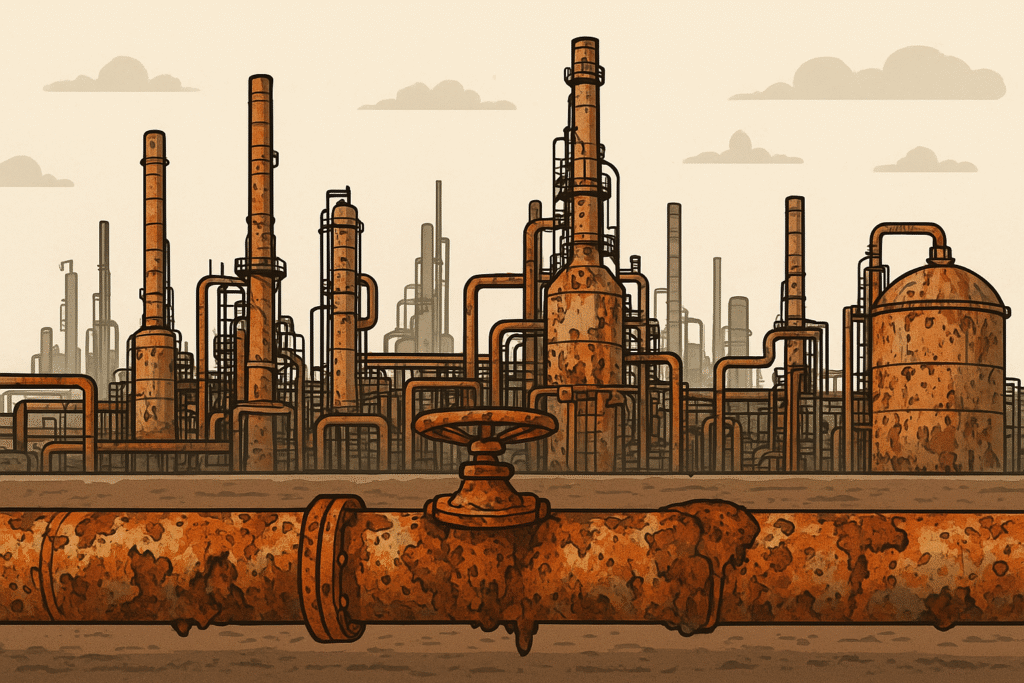
Corrosion is one of the most expensive and persistent operational threats in oil refineries. It weakens equipment, triggers unplanned shutdowns, increases energy consumption, contaminates fuels, and puts workers at risk.
Globally, corrosion costs the oil & gas industry an estimated $60–$80 billion per year, and oil refineries account for a significant share of these losses.
Corrosion rarely appears suddenly—it grows quietly, invisibly, until it forces operators into emergency maintenance or catastrophic failure.
What is Corrosion in Oil Refineries?
Corrosion is the gradual degradation of metals through chemical reactions with their environment. Inside a refinery, these reactions accelerate because the process exposes equipment to:
- High temperatures
- Hydrogen sulfide (H₂S)
- Chlorides
- Organic acids
- Water + hydrocarbons
- High-pressure environments
- Metal catalysts
- Stress and vibration
Refineries are perfect corrosive environments.
Main Types of Corrosion in Refineries
1. High-Temperature Sulfidic Corrosion
Occurs when steel reacts with sulfur compounds at 250–400°C.
Most affected units:
- Atmospheric distillation
- Vacuum distillation
- Hydrotreaters
- FCC units
2. Naphthenic Acid Corrosion (NAC)
Triggered by naphthenic acids at 220–400°C.
Problematic especially in heavy crudes.
3. Wet H₂S Corrosion
Forms iron sulfide, weakening carbon steel pipelines.
High-risk zones: sour water strippers, hydrotreaters, crude units.
4. Chloride Stress Corrosion Cracking (SCC)
Chlorides + moisture + stainless steel = catastrophic cracking.
Especially common in overhead systems.
5. CO₂ Corrosion
Carbonic acid forms when CO₂ dissolves in water → attacks carbon steel.
Impacts crude units, amine systems, process water loops.
6. Under-Deposit & Microbiologically Influenced Corrosion (MIC)
Deposits and bacteria create corrosive microenvironments.
MIC is one of the least detected yet most destructive forms.
Root Causes of Corrosion in Refineries
1. Sour Crudes With High Sulfur
Modern refineries increasingly process sour crudes due to lower cost.
These crudes significantly increase sulfidic corrosion and H₂S damage.
2. High Chloride Concentrations
Chlorides come from:
- Desalter inefficiencies
- Decomposing salts
- Crude blending
They initiate overhead corrosion and SCC.
3. High Naphthenic Acid Content
Common in Venezuelan, Mexican, Middle Eastern, and shale crudes.
4. Water Contamination
Water accelerates:
- CO₂ corrosion
- H₂S corrosion
- Chloride corrosion
- Microbial activity
5. Temperature & Pressure Extremes
Higher temperatures = faster corrosion kinetics.
Pressure drives corrosive compounds deeper into steel.
6. Inefficient Corrosion Inhibitors
Traditional chemical inhibitors (amines, imidazolines, filming agents) often:
- Fail to protect uniformly
- Degrade at high temperature
- Cause environmental, toxicity, and disposal issues
- Increase OPEX and HSE burdens
Curent Solutions in Refineries (and their limitations)
Traditional Corrosion Mitigation
✔ Corrosion inhibitors
✔ Desalter optimization
✔ Overhead corrosion control
✔ Alloy upgrades
✔ Neutralizers
✔ Filming amines
✔ Oxygen scavengers
✔ Inspection & monitoring systems
But refinery operators face major limitations:
- Some inhibitors degrade above 260–300°C
- Many are toxic, carcinogenic, or environmentally regulated
- Disposal costs are increasing
- Some film poorly and leave gaps
- Many require frequent injection or high dosage
- They contribute to VOC emissions and worker exposure risks
Refinery HSE teams are pushing for safer, greener, and more efficient solutions.
The Rise of Green Corrosion Inhibitors
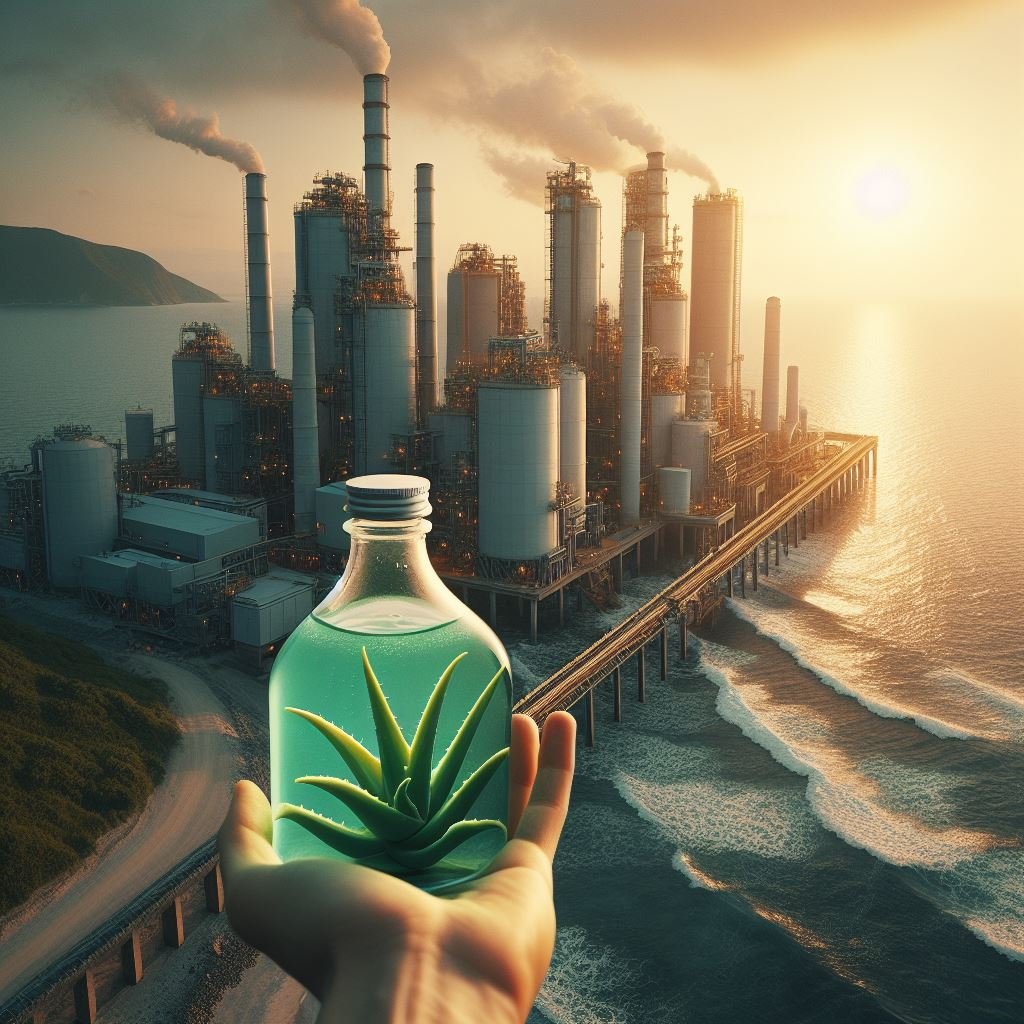
Green corrosion inhibitors (plant-based, biodegradable, non-toxic) provide a new generation of protection with high performance and much lower environmental impact.
Benefits of Green Inhibitors (vs. traditional chemicals)
1. Zero toxicity / zero carcinogens
✔ No amines, imidazolines, or VOCs
✔ Safer for workers
✔ Easier regulatory compliance
2. High efficiency at low dosage
Plant-based molecules form stable, uniform films even at low concentration.
3. Thermal stability
Many green actives maintain film integrity at higher temperatures—critical for refinery operation.
4. Fully biodegradable
✔ Lower environmental footprint
✔ Lower disposal costs
✔ Complies with ESG + sustainability mandates
5. No negative impact on refining catalysts
Some synthetic inhibitors poison catalysts.
Green inhibitors do not create these compatibility issues.
6. Reduced OPEX
Less chemical injection + fewer shutdowns = operational savings.
Why Oil Refineries are Switching to Green Inhibitors
- To eliminate carcinogenic amines & imidazolines
- To reduce worker exposure and HSE risks
- To comply with REACH, EPA, IMO and local regulations
- To meet corporate ESG mandates
- To reduce wastewater toxicity and disposal costs
- To protect high-value equipment for longer service life
Today’s refineries want chemical performance AND sustainability — not one or the other.
Call to Action
If your refinery wants:
✔ Lower corrosion rates
✔ Safer working environments
✔ Lower OPEX
✔ Zero-toxicity, biodegradable chemistry
✔ Improved unit reliability
✔ Alignment with ESG and sustainability goals
Then green corrosion inhibitors are the future of refinery integrity management.