Uses of NocorgreenTM in Oil Refineries
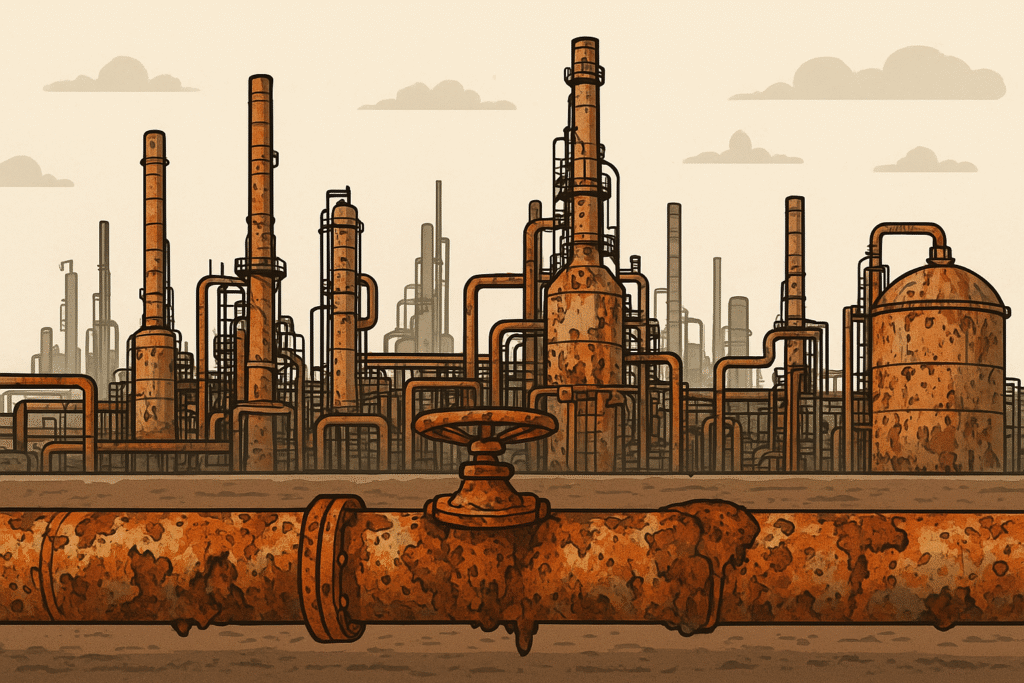
Corrosion is a major, persistent issue in oil refineries, causing billions in damage annually and posing serious safety and environmental risks, causing billions in damage annually and posing serious safety and environmental risks.
Refineries face intense corrosion from processing harsh chemicals, high temperatures, and high pressures, which can lead to equipment failure, leaks, fires, and explosions.
Corrosion inhibitors are used to mitigate such above mentioned issued. NOCORGREEN FULL™ is an innovative green product for use as corrosion inhibitor in many operations at oil & gas refineries.
It was developed to offer an environmentally friendly product and a new “green” option for the corrosion problem in petroleum refineries.
Our aloe based corrosion inhibitor may be used in the following cases:
As a Corrosion Inhibitor for Hydrocracker Units, replacing Ammonium Polysulphide and/or Sodium Polysulphide
As a Corrosion Inhibitor for Desulfurizing Units.
A. NOCORGREENTM as a Corrosion Inhibitor for Hydrocracker Units
Our NOCORGREENTM solution is an Aloe vera based formula being used as a green corrosion inhibitor for carbon steel in acidic environments, forming a protective film by adsorbing bioactive compounds onto the metal surface.
Our field experience on the oil and gas industry and dozen of studies confirm its effectiveness, demonstrating significant reductions in corrosion rates in various acidic and seawater environments.
While it acts as a green, environmentally friendly alternative to synthetic inhibitors, its application in hydrocracker units would require some trials and/or research to confirm its long-term effectiveness, stability, and performance under the high-temperature, high-pressure conditions specific to those units.
Mechanism of Action
Adsorption: NOCORGREENTM contains bioactive compounds like polysaccharides, tannins, and phenolic compounds that adsorb onto the metal surface.
Protective Film Formation: This adsorption forms a protective barrier, or passive layer, on the metal, blocking corrosive agents from reaching the surface.
Inhibitor Type: Studies show that aloe vera acts as a mixed-type inhibitor.
Factors Affecting Performance
Concentration: Higher concentrations of NOCORGREENTM generally lead to greater inhibition efficiency.
Temperature: The inhibitory performance tends to decrease with increasing temperature, although the exact effect can vary depending on the NOCORGREENTM and metal being evaluated.
Environment: Its effectiveness is demonstrated in both acidic media and seawater, though specific results vary with the environment.
Advantages
Green Alternative: As a plant-based extract, aloe vera is considered a green and eco-friendly alternative to traditional synthetic corrosion inhibitors.
Biodegradable: It offers potential benefits in terms of environmental impact.
Limitations for Hydrocracker Units
Harsh Conditions: Hydrocracker units operate under extremely high temperatures and pressures, which can degrade (above 200-300 C) natural compounds like those present in NOCORGREENTM.
Conclusion – Practical Recommendations
1. Corrosion in Hydrocracker Units
Hydrocrackers operate at very high temperature (350–430 °C) and pressure (1,500–3,000 psig), in the presence of:
H2 + H2S → sulfide stress cracking and hydrogen blistering.
NH4HS salts in cold/wet sections → under-deposit corrosion.
Chlorides → HCl + salt deposition, especially in fractionator overheads.
Naphthenic acid attack (NAC) in certain feedstocks.
This means inhibitors must handle both high-temperature sulfide corrosion and wet acid/salt corrosion in the cooler sections.
2. Use of Aloe-Based Corrosion Inhibitors
Aloe extracts present in our NOCORGREENTM solution (polysaccharides, anthraquinones, tannins, saponins) act mainly through film adsorption and metal surface passivation.
They work best in aqueous/H2S systems at moderate temperatures (<300 °C) where they can:
Adsorb strongly on steel, forming a protective organic layer.
Chelate iron ions, reducing further dissolution.
Provide natural surfactancy, ensuring film uniformity in multiphase flows.
✅ NOCORGREENTM – Good applications in hydrocracker units:
Wet high-pressure separator, hot high-pressure separator → where H2S + water co-exist.
Fractionator overhead system → where NH4HS and chlorides cause corrosion.
Condensate systems downstream.
❌ NOCORGREENTM – Not suitable for:
Reactor internals and very high-temperature zones (>320 °C), where aloe decomposes thermally.
Areas prone to hydrogen embrittlement → NOCORGREENTM might offer no protective role there.
3. Comparison to Conventional Inhibitors
Traditional inhibitors:
Imidazolines, amine-phosphates, molybdate blends.
NOCORGREENTM:
Green, biodegradable, safer for operators.
No amines, VOCs, or carcinogenic nitrosamine risks.
Minimum waste treatment costs.
Limited thermal stability compared to synthetic inhibitors.
4. Recommendation
NOCORGREENTM is a good candidate as a corrosion inhibitor in hydrocracker units, but only in wet, moderate-temperature sections (H2S + water zones, overhead condensers, separators).
In reactor high-temperature sections, probably NOCORGREENTM alone is not sufficient, and needs to be part of a hybrid inhibitor package (NOCORGREENTM+ thermal stabilizer + phosphate/molybdate).
Dosage range: 300 to 3000 ppm, depending on the operational time and frequency of dosage, adjusted by corrosion probe or weight-loss coupon testing.
Further details are required to suggest more accurate dosage. Injection method: continuous injection into liquid streams, with batch reinforcement during upsets (e.g., high chloride carryover).
Final Comments
NOCORGREENTM inhibitor is valuable in hydrocracker wet systems (separators, overheads, exchangers), but probably not in the high- temperature hydrogenation reactors.
They can help refiners reduce toxic chemistry use and improve ESG profile, provided they are tested and blended correctly.
B. NOCORGREENTM as for a Corrosion Inhibitor for Desulfurizing Units
Our NOCORGREENTM solution is an aloe vera based formula being used as a green corrosion inhibitor for carbon steel in acidic environments, forming a protective film by adsorbing bioactive compounds onto the metal surface.
Studies and on field experience demonstrate that increasing aloe concentration boosts inhibition efficiency, but this benefit decreases in more aggressive conditions with higher acid strength and temperature.
Use of NOCORGREENTM in desulfurizing units could offer an environmentally friendly and sustainable alternative to synthetic chemical inhibitors.
Mechanism of Action
Protective Film Formation: NOCORGREENTM contains polysaccharides, glycoproteins, and other compounds that adsorb onto the metal surface, creating a physical barrier that protects the underlying steel from corrosive agents like acids.
Adsorption Mechanism: The bioactive constituents in NOCORGREENTM adsorb onto the metal, forming a passive protective layer that hinders corrosion reactions.
Chelating Properties: Aloe polysaccharides present in NOCORGREENTM can chelate metal ions, binding them and preventing them from participating in corrosion reactions.
Factors Affecting Performance
Concentration: Increasing the concentration of NOCORGREENTM generally leads to higher inhibition efficiency.
Environmental Conditions: The effectiveness of NOCORGREENTM decreases in more severe environments characterized by high acid concentrations and elevated temperatures.
Exposure Time: Longer exposure times can reduce the inhibitor’s efficiency.
Advantages of NOCORGREENTM as an Inhibitor
Environmentally Friendly: NOCORGREENTM is a biodegradable and non-toxic product, aligning with the demand for green and sustainable industrial processes.
Readily Available and Renewable: Our aloe vera plantations in Tamaulipas, Mexico, guarantees a year around resource, making it an available, natural, eco-friendly and sustainable option compared to synthetic inhibitors.
Safety: Using natural products can improve workplace safety and reduce the environmental impact of industrial operations.
Potential Applications in Desulfurizing Units
Acidic Media: NOCORGREENTM has shown effectiveness in acidic environments, suggesting its suitability for applications like acid pickling and cleaning of desulfurizing units.
Oil and Gas Industry: NOCORGREENTM is also being used in other corrosive systems, including oil and gas operations, where corrosion is a significant challenge.
Conclusion – Practical Recommendations
1. Corrosion in Desulfurization Units
Hydrotreating and hydrodesulfurization (HDS) units face severe corrosion problems due to:
H2S + water → weak acids (H2S/H2SO4/H2SO3 formation).
Chlorides (hydrochloric acid at high temperature).
Ammonium bisulfide salts (NH4HS under certain conditions).
High pressure + high temperature accelerating metal attack.
Conventional inhibitors are typically amine or imidazoline-based, sometimes blended with phosphates, filming amines, or dispersants.
2. Aloe Extracts as Corrosion Inhibitors
Field evidence shows that our NOCORGREENTM proprietary formulation contains bioactive compounds that can adsorb on steel surfaces and form protective films:
Aloin, anthraquinones, saponins, polysaccharides → act as adsorption agents.
Polyphenols + tannins → chelate metal ions, reducing oxidation.
Natural surfactant properties → improve film-forming ability in multiphase flows. In acidic and H2S-containing environments, our aloe-based inhibitors can reduce corrosion by:
- Forming a passive film on steel surfaces.
- Acting as oxygen scavengers and free-radical suppressors.
- Reducing the need for toxic amines.
3. Advantages vs. Traditional Inhibitors
Non-toxic & biodegradable – meets ESG, REACH, and refinery HSE mandates.
No VOCs, no carcinogenic amines – safer for operators.
Lower life-cycle cost due to reduced handling and waste treatment.
Compatible with refinery metallurgy (carbon steel, Cr-Mo alloys).
4. Limitations & Considerations
Thermal stability: Aloe extracts must be formulated to resist degradation above 250–300 °C (HDS units operate 290–400 °C). This usually requires blending aloe with stabilizers.
Film persistence: Needs periodic dosing (batch or continuous) to maintain surface coverage.
Compatibility: Must be tested with hydrogen, amine gas treating solvents (e.g. MEA/DEA), and sulfur compounds.
5. Practical Recommendation
NOCORGREENTM can work as a sustainable corrosion inhibitor in refinery desulfurization units, but:
- It should be used in a formulated blend (NOCORGREENTM + stabilizer + dispersant).
- Best applied in aqueous injection systems where H2S + water is present.
- Requires field pilot testing to optimize dosage (often 50–300 ppm depending on severity).
Final Comments
Aloe-based inhibitors are a promising green alternative in HDS units, especially for downstream wet sections (separator, absorber, overhead lines) where water + H2S cause aggressive corrosion.
For more information on NOCORGREENTM and our other green products for the Oil, Gas and Petrochemical industries, please write to info (at) aloetradeamerica.com or send a message via the Contact Section.