Natural additives for drilling muds: benefits of aloe solutions in unconventional wells.
Introduction
In the oil and gas industry, drilling mud plays a fundamental role: it stabilizes the wellbore walls, cools the drill bit, and transports cuttings.
However, conventional additives are often composed of synthetic chemicals such as lignosulfonates, aggressive biocides, and surfactants that are difficult to biodegrade.
Faced with increasing environmental and regulatory pressure, natural additives based on aloe vera are emerging as an effective and environmentally friendly alternative.

Why switch to natural additives in drilling mud?
The use of synthetic chemicals carries risks such as:
- Contamination of underground aquifers
- Toxic waste in disposal areas
- Social resistance in communities near wells
- Increased costs for hazardous waste treatment
In contrast, natural additives such as those derived from aloe vera have a much more favorable environmental profile and can perform similar or even better functions than conventional products.

Properties of Aloe Vera in Drilling Mud
Aloe vera is rich in polysaccharides, amino acids, saponins, and phenolic compounds, which provide it with multiple industrial benefits. Among them:
- It acts as a natural viscosifier.
It improves the transport capacity of cuttings without the need for synthetic polymers. - It functions as a biodegradable surfactant.
It reduces the surface tension of fluids, facilitating their circulation. - It has lubricating properties.
It decreases torque and drag, optimizing drilling efficiency. - It has a plant-based biocidal action.
It inhibits the growth of anaerobic bacteria that affect mud quality.
Application in Unconventional Wells and Fracking
In the drilling of horizontal or shale wells (such as in Vaca Muerta or northern Mexico), the extreme conditions require efficient additives that are also compatible with ESG policies. Aloe vera can be integrated as:
- A base additive for water drilling mud
- An environmentally friendly biocide in closed systems
- A lubricant in high-friction or high-wear areas
- A natural pH regulator and biofilm inhibitor

Comparison: Aloe Vera vs. Synthetic Chemicals
| Property | Aloe Vera | Synthetic Additive |
|---|---|---|
| Biodegradability | High | Low or medium |
| Toxicity | No tóxico | Non-toxic Medium to high |
| Surfactant effectiveness | High | High |
| Total cost (use + handling) | Competitive | High (includes waste treatment) |
| ESGA approval | High acceptance | Low compliance |
Aloe vera is a sustainable innovation for the industry
Natural additives based on aloe vera represent a sustainable and viable innovation for drilling operations in unconventional wells.
They not only meet the technical requirements of drilling mud, but also help reduce environmental impact, simplify waste logistics, and improve the image of operating companies with communities and regulators.
Are you developing a new well or looking for solutions for your drilling fluids? Contact Aloetrade America LLC and receive technical advice on our industrial formulations with aloe vera.

At Aloetrade America LLC, we provide industrial products formulated with aloe vera extract ready for integration into oil operations, with international technical support and documentation.
Want to evaluate a field trial in your operation?
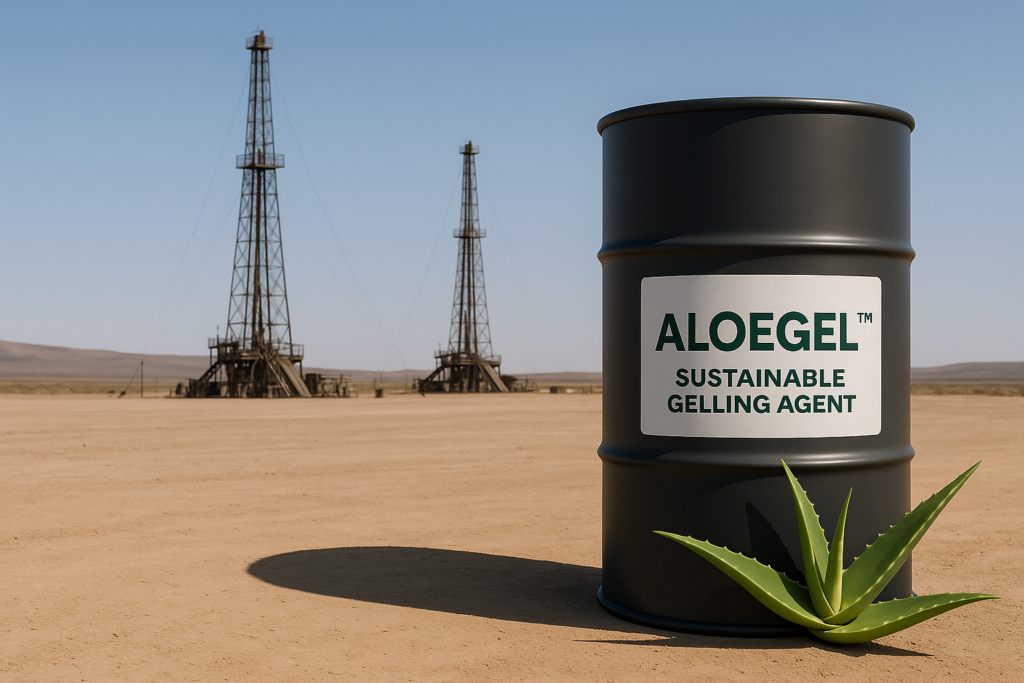
Are you developing a new well or looking for solutions for your drilling fluids?
Contact us today to receive samples, technical data sheets, or personalized advice.
👉 Visit our page of sustainable aloe products for the fracking industry.
On each product page, you’ll find information, technical data sheets, and safety data sheets for each sustainable fracking solution.
Contact us via WhatsApp
