Uses of NOCORGREEN™ in Oil Refineries
The following article intends to explain the potential use of our aloe based NOCORGREEN™ solution as a Corrosion Inhibitor for Hydrocracker Units
Our NOCORGREEN™ solution is an Aloe vera based formula being used as a green corrosion inhibitor for carbon steel in acidic environments, forming a protective film by adsorbing bioactive compounds onto the metal surface.
Our field experience on the oil and gas industry and dozen of studies confirm its effectiveness, demonstrating significant reductions in corrosion rates in various acidic and seawater environments.
While it acts as a green, environmentally friendly alternative to synthetic inhibitors, its application in hydrocracker units would require some trials and/or research to confirm its long-term effectiveness, stability, and performance under the high-temperature, high-pressure conditions specific to those units.

Mechanism of Action
Adsorption: NOCORGREEN™ contains bioactive compounds like polysaccharides, tannins, and phenolic compounds that adsorb onto the metal surface.
Protective Film Formation: This adsorption forms a protective barrier, or passive layer, on the metal, blocking corrosive agents from reaching the surface.
Inhibitor Type: Studies show that aloe vera acts as a mixed-type inhibitor.
Factors Affecting Performance
Concentration: Higher concentrations of NOCORGREEN™ generally lead to greater inhibition efficiency.
Temperature: The inhibitory performance tends to decrease with increasing temperature, although the exact effect can vary depending on the NOCORGREEN™ and metal being evaluated.
Environment: Its effectiveness is demonstrated in both acidic media and seawater, though specific results vary with the environment.
Advantages
Green Alternative: As a plant-based extract, aloe vera is considered a green and eco-friendly alternative to traditional synthetic corrosion inhibitors.
Biodegradable: It offers potential benefits in terms of environmental impact.
Conclusion – Practical Recommendations
1. Corrosion in Hydrocracker Units
Hydrocrackers operate at very high temperature (350–430 °C) and pressure (1,500–3,000 psig), in the presence of:
- H₂ + H₂S → sulfide stress cracking and hydrogen blistering.
- NH₄HS salts in cold/wet sections → under-deposit corrosion.
- Chlorides → HCl + salt deposition, especially in fractionator overheads.
- Naphthenic acid attack (NAC) in certain feedstocks.
This means inhibitors must handle both high-temperature sulfide corrosion and wet acid/salt corrosion in the cooler sections.
2. Use of Aloe-Based Corrosion Inhibitors
Aloe extracts present in our NOCORGREEN™ solution (polysaccharides, anthraquinones, tannins, saponins) act mainly through film adsorption and metal surface passivation.
They work best in aqueous/H₂S systems at moderate temperatures (<300 °C) where they can:
- Adsorb strongly on steel, forming a protective organic layer.
- Chelate iron ions, reducing further dissolution.
- Provide natural surfactancy, ensuring film uniformity in multiphase flows.
✅ NOCORGREEN™ – Good applications in hydrocracker units:
- Wet high-pressure separator, hot high-pressure separator → where H₂S + water co-exist.
- Fractionator overhead system → where NH₄HS and chlorides cause corrosion.
- Condensate systems downstream.
❌ NOCORGREEN™ – Not suitable for:
- Reactor internals and very high-temperature zones (>320 °C), where aloe decomposes thermally.
- Areas prone to hydrogen embrittlement, where NOCORGREEN™ might offer no protective role there.
3. Comparison to Conventional Inhibitors
Traditional inhibitors: imidazolines, amine-phosphates, molybdate blends.
NOCORGREEN™:
- Green, biodegradable, safer for operators.
- No amines, VOCs, or carcinogenic nitrosamine risks.
- Minimum waste treatment costs.
- Limited thermal stability compared to synthetic inhibitors.
4. Recommendations
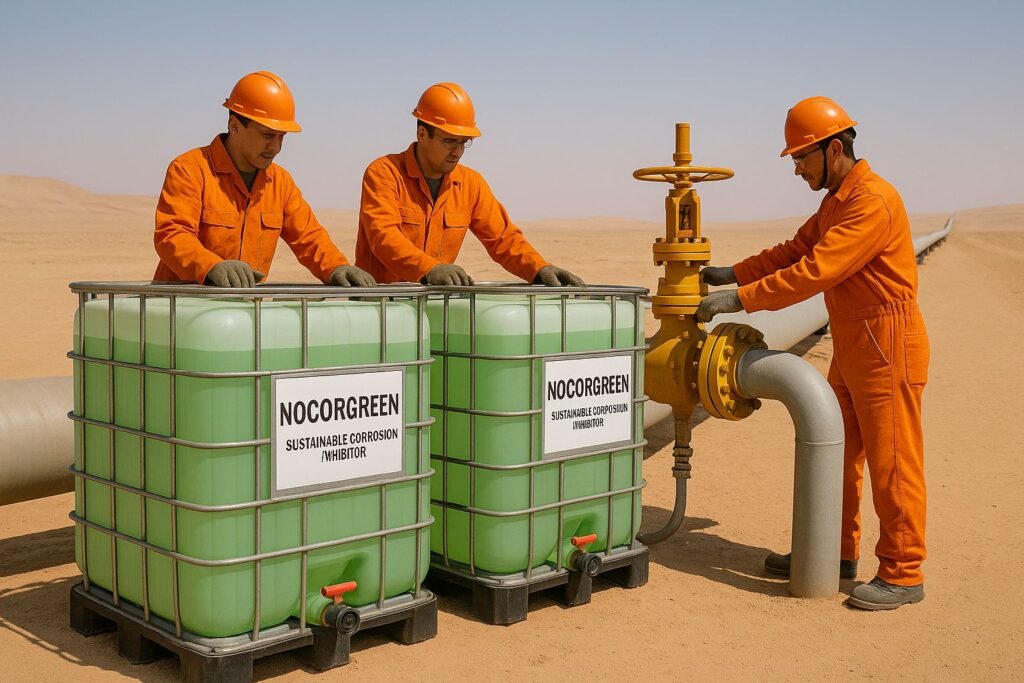
NOCORGREEN™ is a good candidate as a corrosion inhibitor in hydrocracker units, but only in wet, moderate-temperature sections (H₂S + water zones, overhead condensers, separators).
In reactor high-temperature sections, probably NOCORGREEN™ alone is not sufficient, and needs to be part of a hybrid inhibitor package (NOCORGREEN™ + thermal stabilizer + phosphate/molybdate).
Dosage range: 300 to 3000 ppm, depending on the operational time and frequency of dosage, adjusted by corrosion probe or weight-loss coupon testing. Further details are required to suggest more accurate dosage.
Injection method: continuous injection into liquid streams, with batch reinforcement during upsets (e.g., high chloride carryover).
Final Comments
NOCORGREEN™ inhibitor is valuable in hydrocracker wet systems (separators, overheads, exchangers), but probably not in the high-temperature hydrogenation reactors.
They can help refiners reduce toxic chemistry use and improve ESG profile, provided they are tested and blended correctly.