Invest in Aloe Farming in Kenya
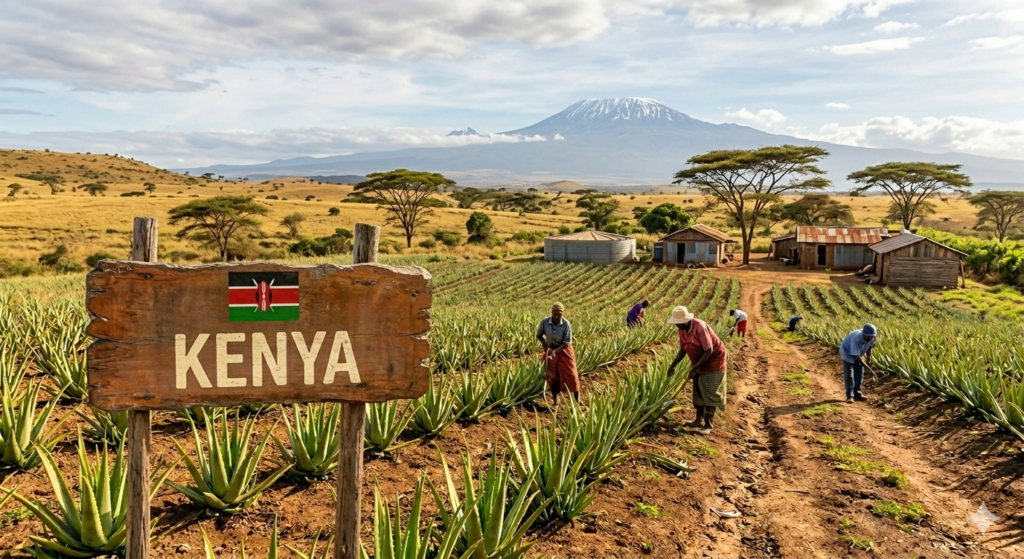
Kenya, officially the Republic of Kenya, is a country located in East Africa, with a population of more than 53 million as of mid 2025. Kenya’s capital and largest city is Nairobi. The second-largest and oldest city is Mombasa, a major port city.
Kenya’s geography, climate and population vary widely. In western Rift Valley counties, the landscape includes cold, snow-capped mountaintops (such as Batian, Nelion, and Point Lenana on Mount Kenya) with vast surrounding forests, wildlife, and fertile agricultural regions in temperate climates.
In other areas there are dry, arid, and semi-arid climates, as well as absolute deserts (such as the Chalbi Desert and Nyiri Desert), where most of wild aloe occur. Typical wild aloe varieties found in Kenya are aloe turkanensis and aloe secundiflora, but they are extracted for aloe sap, not for juice production. Those are endangered species of aloes.
Current Situation of Aloe Vera Farming in Kenya
- Growing Popularity: Aloe vera farming has been gaining traction in Kenya as farmers seek alternative cash crops. The demand for aloe vera both domestically and internationally is spurred by its applications in health, beauty, and wellness products.
- Export Potential: Kenya is strategically positioned to leverage exports to various international markets, especially in Europe and North America, where there is a rising demand for natural and organic products.
- Government and NGO Support: There are initiatives from both the government and non-governmental organizations (NGOs) aiming to promote aloe vera cultivation. Many programs provide training, resources, and financial assistance to farmers interested in cultivating this versatile plant.
- Research and Development: Ongoing research efforts are improving the understanding of aloe vera’s medicinal properties and optimal growing conditions, enhancing productivity and the quality of the gel produced.
Competitive Advantages for Investing in Aloe Vera Farming in Kenya
- Suitable Climate: Kenya’s diverse climatic conditions, particularly in regions like Eastern and Northern Kenya, are favorable for aloe vera cultivation. The plant is hardy and thrives in arid and semi-arid areas, requiring less water compared to other crops.
- Rich Soil: The sandy loam soil in many areas of Kenya is ideal for aloe vera growth, which supports healthy plant development and higher yields.
- Growing Domestic Market: There is an increasing domestic demand for aloe vera products such as juices, gels, and cosmetics, created by a rising awareness of health and wellness among consumers.
- Export Opportunities: Kenya can export processed aloe vera products, including gels and supplements, to markets in Europe, North America, and Asia. This opens up potential for higher profit margins compared to selling raw aloe.
- Diverse Product Range: Aloe vera can be processed into various products, including cosmetics, dietary supplements, and beverage ingredients, providing multiple avenues for generating income.
- Sustainable Agriculture Alignment: Investing in aloe vera farming aligns with sustainable agricultural practices, which is increasingly important to consumers and markets globally.
Key Attractiveness of Investing in Aloe Vera Projects in Kenya
- High-Growth Market: The expanding market for natural and organic products presents a significant opportunity for investors.
- Government Incentives: Support from government and organizations can reduce start-up and operational costs, making the investment more feasible.
- Diversification: Aloe vera offers farmers a chance to diversify their agricultural portfolios, reducing risks associated with dependency on traditional crops.
- Sustainability Appeal: The potential for eco-friendly farming practices attracts consumers and investors who prioritize sustainability.
Our Suggestions
Investing in aloe vera farming in Kenya is highly attractive due to favorable climatic conditions, a growing market for products, supportive government policies, and the opportunity to engage in sustainable agricultural practices. This makes it a compelling option for investors looking to tap into the lucrative global health and wellness industry.
Technical Assistance Services to Invest in the Kenya Aloe Business
If you wish to invest in aloe business and aloe farming in Kenya, we can offer technical assistance services.
A simple option is to buy our training course on Aloe Vera Farming in KENYA. Otherwise, if you require specific and tailor made technical assistance service, please contact to us.
The course include
- A written document (in PDF format) is sent on a digital version with the general content and specific topics describe below. The document was written by Aloetrade America LLC staff.
- b. An online support via chat and email for questions related to the document provide. The chat and email replies are answered by Aloetrade America LLC staff.
TRAINING PROGRAMS – DISTANCE LEARNING COURSE
AGRICULTURAL ASPECTS OF ALOE VERA CULTIVATION AND PRODUCTION (ALOE BARBADENSIS MILLER) IN KENYA
Table of Contents
- INTRODUCTION
1.1. ORIGIN OF ALOE
1.2. PRODUCTION AREAS
1.3. HISTORY OF ALOE - THE PLANT
2.1. GENERAL AND BOTANICAL CHARACTERISTICS
2.2. BOTANICAL CLASSIFICATION
2.3. BRIEF EXPLANATION OF VARIETIES (+) - DESCRIPTION OF ALOE VERA L (+)
- PROPERTIES AND APPLICATIONS OF ALOE
4.1. PROPERTIES OF ALOE
4.2. ACTIVE INGREDIENTS
4.3. MEDICINAL PROPERTIES
4.4. THERAPEUTIC APPLICATIONS
4.5. BASIC PROPERTIES
4.6. GENERAL USES - ALOE PRODUCTION IN KENYA
- INTERNATIONAL REGULATORY FRAMEWORK
- PRODUCTION AND CULTIVATION
7.1. INTRODUCTION – PREFERRED CULTIVATION AREAS
7.2. TECHNICAL ASPECTS OF CULTIVATION
7.2.1. CROP VARIETY
7.2.2. SUPPLY OF SPROUTS (+)
7.2.3. SOWING TIME
7.2.4. SOIL AND MOISTURE ASPECTS – LIGHT CONDITIONS – • SOIL CONDITIONS – COMPOST AND FERTILIZERS (+)
7.2.4. LAND PREPARATION (ALSO IN +)
7.2.5. SOWING – SOWING PROCESS – SOWING MATERIAL – SOWING METHODS – SOWING DENSITY – EQUIPMENT NECESSARY FOR SOWING (+)
7.2.6. REQUIRED CLIMATIC CONDITIONS
7.2.7. AGRICULTURAL CYCLE
7.3. CULTIVATION AND MAINTENANCE PRACTICES
7.4. WATER REQUIREMENTS – IRRIGATION SYSTEMS (+)
7.5. PLANT PROTECTION – WEED CONTROL – HERBICIDES (+)
7.6. DISEASE CONTROL – PEST CONTROL (+)
7.7. FUNGI AND BACTERIA THAT AFFECT ALOE (+)
7.8. HARVESTING – • HARVESTING PROCESS (+) - MAIN PARAMETERS OF AN ALOE PLANTATION (+)
- VOLUME ESTIMATES FOR A TYPICAL PROJECT (+)
- SUGGESTIONS – GOOD AGRICULTURAL PRACTICES TO FOLLOW (+)
- FINAL RECOMMENDATIONS ON THE PLANTATION (+)
- USES OF AI IN ALOE CULTIVATION
Aloetrade America LLC provides participants with a digital document, written in english, sent by email. After the purchase, the original document is updated and it takes 3 to 5 working days for final delivery.
The tutoring system includes the assistance of a tutor who answers reading comprehension questions via email or through Whastapp chat.
The course is not in-person, but rather online.
Certificates of participation are not issued, as this is a training manual.
Answers to questions are exclusively related to the content of each course. Aloetrade is not obligated to provide binding technical assistance, which is sold separately.
BUY OUR DISTANCE LEARNING COURSE ”AGRICULTURAL ASPECTS OF ALOE VERA CULTIVATION AND PRODUCTION (ALOE BARBADENSIS MILLER) IN KENYA” USD 1,400.00